


Cladding
Clad
past tense of clothe
transitive verb: to cover or clothe
Cladding is one of those words that gets used but not commonly enough for everyone to have an instant picture of what it is when you use it. When one says it, you can tell that the listener has to take a moment to register what it means.
I think the reason for this is that most walls are made of brick. Cladding is used as an additional 'skin' or layer on the outer wall of some buildings (the Grenfell tower had flammable cladding but I actually can't picture it). Sheds have cladding because they require 'clothing' - it actually goes on a bit like armour (see below):

This is lap cladding. I know you're dying to say 'tongue and groove' cladding, but today's not the day, my hairy friend. Your time will come...
But before all the tessalating fun and games began, old Uncle Sammy had to trek off to West Hampstead in the morning and retrieve all this fantastic wood from somebody's garden. It was a FreeCycle find - a noble gentleman had it as the facade of his house since the 1970s and when he took it off to replace it with newer stuff, he couldn't bear to throw it away. I agree - this is useful stuff! The wood from that era was made from better stuff. Back when wood was wood...
The treatment process for adding wood preserver was more thorough. Nowadays your standard stuff is sprayed or coated with chemicals. Back in the 1970s hardwood was pressurised in water meaning that wood from that era is solid and durable throughout the cross-section. No weak bits or breaking points. The modern stuff is less durable. Splinters and bows more easily. I don't know exactly what each process involves but from my experience of many various woods over the years, I can tell you that things were actually better back then (in wood terms).

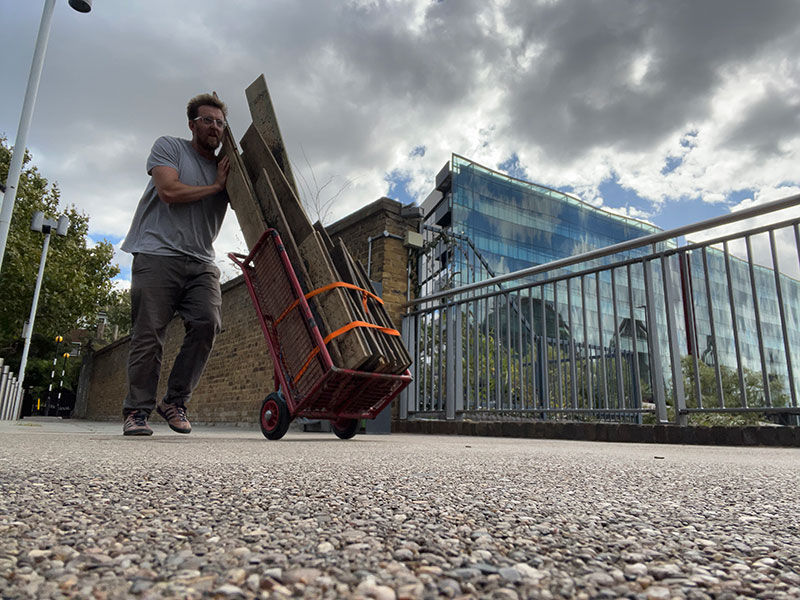
Parked in the disabled parking bay near the canal (sorry, universe) and shipped about 5 trolley loads down the ramp and onto the boat.
Rosie was due to come and help and it was sods law that all the gruelling menial tasks I had to do solo and as soon as they were done, the help appears!

I want Rosie to get as much experience with power tools and making things as possible because I know it will be useful/fun for later in life. I have gained so much enjoyment from carpentry over the years and it is all learnt from trying to do it. I want others to experience the same joy but I know people feel like there are invisible barriers to learning. So I force her to work for me for free.
The trick with drivers / drills is to keep a straight line from the tip of the screw to the back of the machine. This takes hundreds of iterations to understand. If the driver / drill is pointed up towards the sky at 80 degrees and you want to screw something at 90 degrees, the head of the driver is going to 'cam out' ie. pop out of the screw head. If the angle of the driver and the angle of the screw are identical, you will get a smooth entry. That is the ultimate screw experience. 'The hole in one' I call it. You then have to master the variable of button pressure (the driver's button is pressure-sensitive) and for true mastery, applying pressure from the back of the machine - sometimes required.*
*This contradicts another rule of thumb which is that the tool is doing 1,000 times more work than you forcing it is going to do. Applying extra pressure is insignificant in the exchange of energy when using a tool. Allow the tool to do the work. Additionally, not forcing things is A LOT safer. Forcing things mechanically risks things jumping out of place at high speed and jamming into your beautiful flesh. Staying calm and patient maintains your composure and accuracy as well as keeps you safe.


Rosie had to go at 3pm and I finished off the fiddly bits at the top. At 5pm I drove to Angel to pick up a second hand William Morris themed dog bowl for Ellie.
Bonus feature:
There is a bent screw in the horizontal beam above the double doors. I do not possess an angle grinder (I hope Santa Claus brings me one) so I can't get the screw out. So to honour the reality of not having the appropriate tool, I executed a work-around AKA a bodge: I cut the piece of cladding to fit over the screw and drilled a hole in the hardwood. I fed the wood over the bent screw and attached the cladding. Does that make sense? That was hard to explain. When you come to the boat, look over the double doors to the left and you'll see a funny little screw head poking out of the cladding. It's a feature.


Comments